You’ve probably seen it before — a little box at checkout that says “Enter promo code” or “Got a coupon?” You might have typed something in, crossed your fingers, and hoped for the best. Or maybe you’ve skipped it entirely, unsure of what those codes even are or where to find them.
Either way, you’re not alone.
Millions of Americans shop online every single day without fully understanding how coupon codes work — and without realizing how much money they’re leaving on the table. According to industry reports, shoppers who actively use coupon codes save hundreds of dollars every year on purchases they were already planning to make.
This guide is going to change that for you.
By the end of this article, you’ll know exactly what coupon codes are, how they work, what different types exist, and — most importantly — where to find ones that actually work so you can start saving on your very next purchase.
What Is a Coupon Code, Exactly?
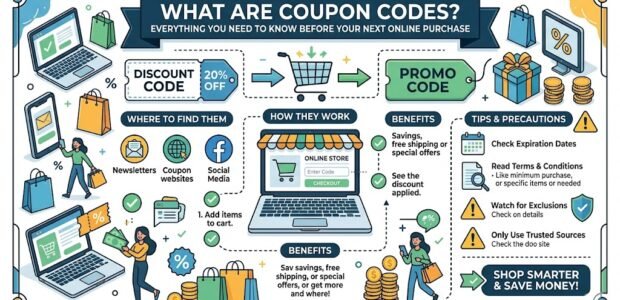
A coupon code is a short string of letters, numbers, or both that you enter at an online store’s checkout page to receive a discount on your order. You might also hear them called promo codes, discount codes, offer codes, or voucher codes — they all refer to the same thing.
Think of it as a digital key. When you enter the right code at checkout, it “unlocks” a discount that the retailer has pre-set in their system. That discount could be a percentage off your total, a fixed dollar amount, free shipping, or a special bonus offer like a free gift with purchase.
Here’s a simple example: You’re buying a pair of running shoes at an online store. The total comes to $89.00. You visit a site like Discode.us, find a 20% off promo code for that store, enter it at checkout, and your total drops to $71.20. You just saved $17.80 without doing anything differently — you were going to buy the shoes anyway.
That’s what a coupon code does. It’s genuinely that simple.
A Brief History: From Paper Clips to Digital Codes
To understand why coupon codes exist, it helps to know where they came from.
The concept of the coupon is actually over 130 years old. The first known coupon was issued by Coca-Cola in 1887 — a handwritten ticket for a free glass of their syrup. By the early 20th century, paper coupons had become a staple of American retail life, offering small discounts on groceries, household goods, and everyday products.
Fast forward to the rise of e-commerce in the 1990s and early 2000s. As shopping moved online, retailers needed a way to replicate the coupon experience in a digital environment. The solution was simple: alphanumeric codes that customers could type into a text field at checkout.
Today, coupon codes are a massive part of the online shopping ecosystem. Retailers use them strategically to attract new customers, reward loyal shoppers, clear out seasonal inventory, and compete with rivals. The result is a constant stream of discount opportunities — if you know where to look.
How Do Coupon Codes Actually Work?
Behind the scenes, coupon codes are connected to specific rules in a retailer’s system. When you enter a code at checkout, the website checks that code against its database and applies whatever discount is attached to it — if the code is valid.
Here’s what determines whether a code works:
Validity Period Every coupon code has an activation date and, in most cases, an expiration date. A code that worked last month might be completely dead today. This is one of the biggest reasons people enter codes that don’t work — they’re using outdated ones from unreliable sources.
Usage Limits Some codes are designed for one-time use only, while others can be used by multiple people. Retailers often release “limited quantity” codes that stop working once a certain number of people have used them.
Minimum Order Requirements Many discount codes only activate if your order meets a minimum purchase threshold. For example, a code might give you $15 off, but only on orders of $75 or more. If your cart total is $60, the code won’t apply.
Product or Category Restrictions Some codes are limited to specific product categories or brands. A code for 20% off clothing might not work on electronics from the same store, even if they’re in the same cart.
Customer Eligibility Certain codes are reserved for specific customers — new shoppers, email subscribers, loyalty program members, or people in a specific geographic location. A “first-time buyer” code won’t work if you’ve already placed an order with that retailer.
Understanding these rules helps you choose the right code and avoid unnecessary frustration at checkout.
The Main Types of Coupon Codes
Not all coupon codes offer the same kind of discount. Here’s a breakdown of the most common types you’ll encounter when shopping online in the US:
Percentage Off Codes
These are the most widely used type of promo code. They take a set percentage off your order total, a specific product, or a product category. Common examples include codes for 10%, 15%, 20%, or even 50% off.
Percentage codes are most valuable on larger purchases. A 20% discount on a $200 item saves you $40 — a significant amount. On a $15 item, the same code only saves you $3.
Dollar Amount Off Codes
Instead of a percentage, these codes give you a fixed dollar amount off. You might see codes like “$10 off your order” or “$25 off purchases over $100.”
Dollar amount codes tend to be more valuable on smaller orders where a percentage discount wouldn’t add up to much. On a $30 order, a $10 off code gives you roughly 33% in savings — better than most percentage-based codes.
Free Shipping Codes
Shipping costs are one of the top reasons American online shoppers abandon their carts without completing a purchase. A free shipping code removes that extra charge entirely.
Depending on what you’re ordering and from where, shipping costs can range from a few dollars to $20 or more. Free shipping codes are particularly valuable for heavy or bulky items.
BOGO and Bundle Deals
BOGO stands for “Buy One Get One.” These deals let you get a second item free — or at a discounted price — when you purchase the first. They’re extremely common in the fashion, beauty, and food delivery categories.
Bundle codes work similarly, giving you a discount when you purchase a specific combination of products together.
Seasonal and Event-Based Codes
Retailers release special codes tied to major shopping events and holidays throughout the year. The biggest in the US include:
- Black Friday (day after Thanksgiving) — often the deepest discounts of the year
- Cyber Monday — online-specific deals that extend the Black Friday sales
- Labor Day Weekend — major discounts on furniture, appliances, and home goods
- Back-to-School Season (July–September) — discounts on clothing, supplies, and electronics
- Valentine’s Day, Mother’s Day, Christmas — category-specific promotions
Planning your bigger purchases around these events and pairing them with coupon codes can lead to dramatic savings.
Loyalty and Referral Codes
Many online retailers have referral programs where existing customers receive a unique code to share with friends. When a new customer uses that code, both parties receive a discount or credit. Loyalty programs often give members exclusive codes that aren’t available to the general public.
Where Do Coupon Codes Come From?
Coupon codes originate from the retailers themselves, but they spread through several different channels. Understanding these channels helps you find the best deals:
Retailer Websites and Email Lists The most direct source. If you’re signed up for a store’s email newsletter, you’ll often receive exclusive discount codes directly in your inbox — welcome discounts for new subscribers, birthday offers, and seasonal promotions.
Social Media and Influencer Partnerships Brands frequently partner with content creators, bloggers, and social media influencers who share unique codes with their audiences. Following your favorite brands on Instagram, TikTok, or YouTube can surface deals you wouldn’t find elsewhere.
Coupon Aggregator Platforms This is where dedicated coupon sites come in. Platforms like Discode.us collect promo codes from hundreds of retailers and display them in one place. Instead of visiting dozens of brand websites or signing up for dozens of email lists, you can find and compare deals from multiple stores in a single location.
Browser Extensions Some browser extensions automatically detect when you’re shopping online and apply available coupon codes at checkout without any effort on your part. These are convenient but don’t always have the most comprehensive or up-to-date code libraries.
Affiliate and Deal Communities Online communities focused on frugal living and deal-hunting often share newly discovered promo codes. These can be gold mines for limited-time offers, but the quality and reliability vary significantly.
Why Using a Verified Coupon Site Matters
Here’s something important that most guides don’t tell you: the majority of coupon codes listed on the internet don’t actually work.
That’s not an exaggeration. Because coupon codes expire, get used up, or are simply entered incorrectly on coupon sites, shoppers frequently encounter invalid codes that generate nothing but frustration. Some coupon websites have thousands of dead codes sitting on their pages because they never verify whether the codes still work.
This is why using a platform that prioritizes validation makes a real difference.
Discode.us takes a different approach by focusing on verified and validated coupons. When you browse deals on Discode.us, you can see the validation status of each code — giving you far more confidence that the discount you’re about to apply will actually go through at checkout.
The platform covers popular stores that American online shoppers use regularly, including major global marketplaces for electronics, fashion, and everyday goods. The interface is clean and simple — you find your store, click to reveal your code, copy it, and you’re done. No pop-up maze, no misleading “click here” games, no expired listings buried under stacks of outdated deals.
For people who are new to using coupon codes, Discode.us is genuinely one of the easiest places to start.
Step-by-Step: How to Use a Coupon Code at Checkout
If you’ve never used a coupon code before, here’s exactly what the process looks like from start to finish:
Step 1 — Shop as normal. Add the items you want to your cart on the retailer’s website. Don’t checkout yet.
Step 2 — Visit Discode.us. Open a new tab and go to discode.us. Search for the store you’re shopping at or browse by category.
Step 3 — Find a relevant deal. Look through the available coupon codes for your store. Pay attention to the discount amount, any conditions listed, and the expiration date.
Step 4 — Copy the code. Click “Get Code” to reveal the coupon code. Copy it — most platforms let you do this with a single click.
Step 5 — Return to checkout. Go back to the retailer’s website and proceed to checkout. Look for a field labeled “Promo Code,” “Coupon Code,” “Discount Code,” or “Gift Card.” Paste your code into that field.
Step 6 — Apply and confirm. Click “Apply” or “Submit” and watch your order total update. If the code is valid and your order meets any requirements, the discount will appear immediately.
Step 7 — Complete your purchase. Finish checking out and enjoy your savings.
The whole process — from opening Discode.us to completing your purchase — takes less than three minutes.
Common Reasons a Coupon Code Might Not Work
Even with verified codes, you might occasionally run into issues. Here are the most common reasons a code fails at checkout and what to do about it:
The code has expired. Check the expiration date listed on the coupon page. If the code has passed its end date, it won’t work. Look for a newer code from the same retailer.
Your order doesn’t meet the minimum. Double-check whether the code requires a minimum purchase amount. Adding one more item to your cart might bring you over the threshold.
The code applies to a different category. Some codes are category-specific. A code for clothing won’t apply to electronics. Read the code description carefully.
You’ve already used this code. One-time-use codes can only be applied once per customer account or email address.
Typos. Even a single wrong character breaks a code. If you’re typing it manually, switch to copy-paste to eliminate this issue.
The code is for new customers only. If you’ve ordered from the retailer before, new-customer codes won’t apply to your account.
The Real Financial Impact of Coupon Codes
Let’s talk numbers for a moment, because this is where things get genuinely interesting.
The average American household spends a significant amount each year on online purchases — clothing, electronics, home goods, subscriptions, and more. Even conservative estimates suggest that consistent coupon code use can save the average shopper between $300 and $700 per year, depending on their shopping habits and how diligently they look for deals.
For heavier online shoppers, that number can easily exceed $1,000 annually.
The key word there is “consistent.” The shoppers who save the most are the ones who make checking for coupon codes a regular habit — not just something they do when they happen to remember. Making it a rule to check Discode.us before completing any online purchase takes almost no additional time and can pay off significantly over the course of a year.
Final Thoughts: Start Small, Save Big
Coupon codes aren’t a complicated financial strategy or a time-consuming hobby. At their core, they’re just a way of paying less for things you were already planning to buy — and that’s something everyone can appreciate.
Now that you understand what coupon codes are, how they work, the different types available, and where to find verified ones that actually work, you’re fully equipped to start saving on every online purchase you make.
Start with your next order. Before you click that final checkout button, take 60 seconds to check Discode.us for an available deal. You might be surprised how often there’s a code waiting for you.
Smart shopping isn’t about buying less. It’s about paying less for what you love.
Bookmark Discode.us today and never miss a deal. Subscribe to the weekly newsletter for the best promo codes delivered straight to your inbox every week.